Search
16
Apr
Why Small Car Problems Turn Into Expensive Repairs (And How to Avoid It)
Avoid expensive car repairs by fixing small issues early. Get expert diagnostics, smog testing, and full auto repair in Antioch, CA 94509.
Don’t wait until a small issue becomes a major repair.
Schedule your diagnostic service today and keep your vehicle running safely, efficiently, and reliably.
The Hidden Cost of Waiting
Most vehicle problems don't begin with a breakdown.
They start quietly.
A faint noise when you accelerate. A slight delay when shifting gears. An air conditioner that doesn't cool like it used to. Or a check engine light that turns on — then disappears.
It's easy to ignore these signs. Life is busy, and your car still runs, so it doesn't feel urgent.
But here's the reality: small car problems rarely stay small.
At King Auto Care in Antioch, CA 94509, we see this pattern every day. Drivers come in only after a minor issue has turned into a major repair — costing far more than it would have if addressed early.
This guide will help you understand:
- Why small issues become expensive repairs
- The warning signs you should never ignore
- How professional diagnostics can save you money
- What smart car owners do differently — and how you can too
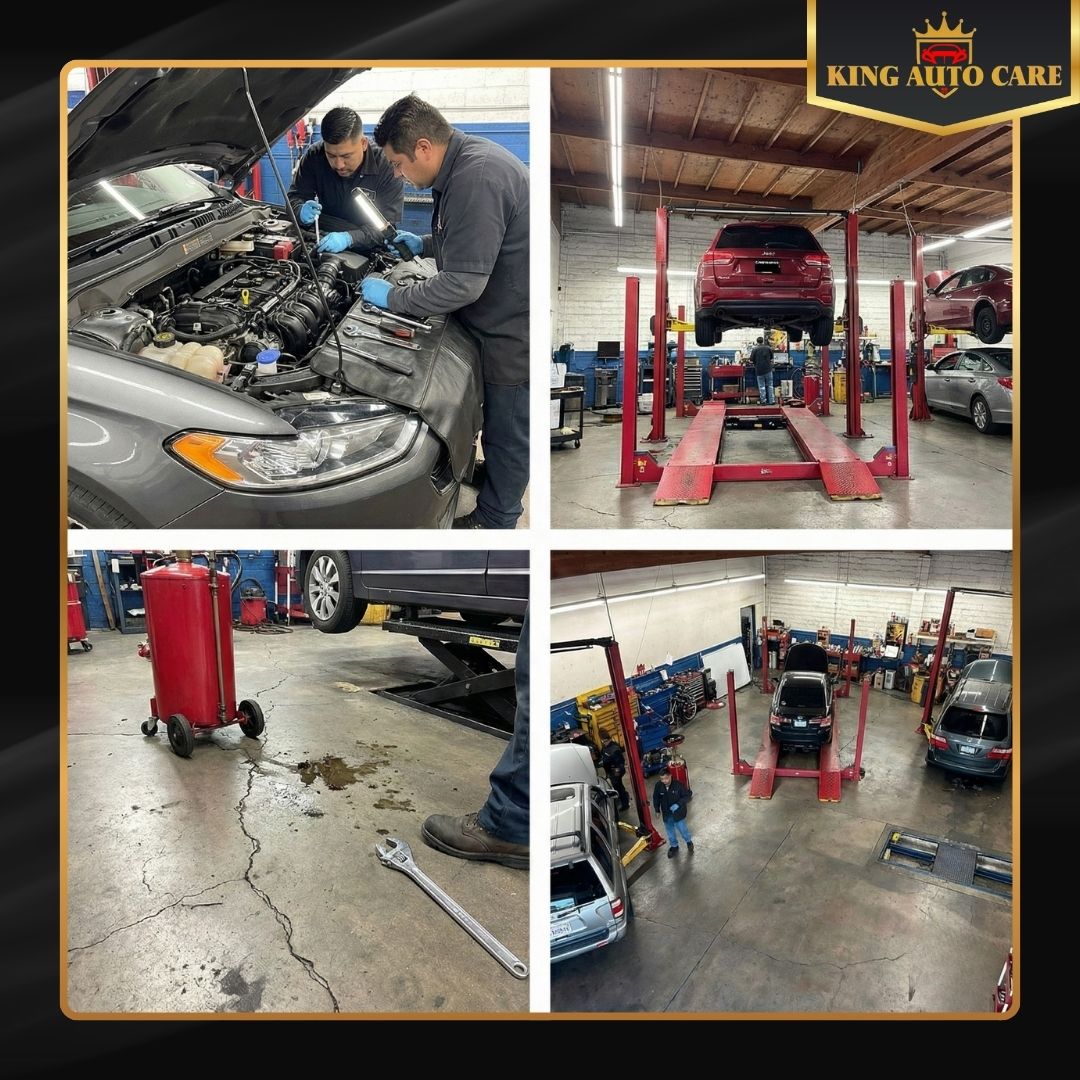
The Most Common Car Problems Drivers Ignore in Antioch, CA
Many drivers assume that if a car is still running, it's fine. But modern vehicles are complex, interconnected systems — and even small irregularities can signal deeper issues hiding beneath the surface.
Here are the most commonly ignored warning signs we see at our auto repair shop in Antioch, CA:
1. Check Engine Light — On and Off
This is one of the most misunderstood signals in any vehicle. Many drivers dismiss it if the car feels normal or the light goes away on its own.
But the check engine light can indicate:
- Faulty oxygen or mass airflow sensors
- Emission control problems
- Fuel system inefficiencies
- Early-stage engine performance issues
When that light turns off temporarily, it doesn't mean the problem resolved itself — it often means the vehicle's computer logged a fault and moved on. The underlying issue is still there.
Ignoring a check engine light can lead to failed California smog tests, reduced fuel economy, and long-term engine damage. A quick diagnostic scan in Antioch costs a fraction of what deferred repairs will.
2. Slight Delay in Acceleration or Gear Shifting
Does your car hesitate when you press the gas? Does it pause slightly before engaging a gear?
These are early symptoms of:
- Transmission wear — internal clutch packs or solenoids beginning to fail
- Low or degraded transmission fluid — causing slipping and heat buildup
- Drivetrain issues — affecting how power is transferred to the wheels
- Throttle body or fuel delivery problems — causing hesitation under load
At this early stage, a fluid service or sensor replacement may be all that's needed. Wait long enough, and you're looking at a full transmission overhaul — one of the most expensive repairs in any vehicle.
3. Reduced Fuel Efficiency
If you're filling up more frequently without driving more miles, your vehicle is telling you something is wrong.
Common causes of declining fuel economy include:
- Dirty or clogged fuel injectors — preventing proper fuel atomization
- Failing oxygen sensors — causing the engine to run rich or lean
- A clogged air filter — restricting airflow and forcing the engine to work harder
- Worn spark plugs — leading to incomplete combustion
- Engine oil that's overdue for a change — increasing internal friction
Beyond the added cost at the pump, poor fuel efficiency is a symptom of an engine operating below its design parameters. Left unaddressed, the root cause continues to degrade other components.
4. Weak or Inconsistent Air Conditioning
In Antioch's hot Central Valley summers, a properly functioning AC system isn't a luxury — it's a safety necessity. Cabin temperatures in a parked car can exceed 140°F, and driving with inadequate cooling creates real fatigue and distraction risks.
If your AC is:
- Taking longer than usual to cool down the cabin
- Blowing warm or room-temperature air
- Producing weak airflow even at maximum fan speed
- Making clicking or hissing sounds when activated
…it could be caused by:
- Refrigerant leak — the most common cause; refrigerant escapes through micro-cracks in hoses or fittings
- Compressor wear — the heart of the AC system, prone to failure when run low on refrigerant
- Electrical faults — in the blower motor, relays, or control module
- Blocked condenser — reducing the system's ability to shed heat
Early AC repair in Antioch is typically a refrigerant recharge or minor seal replacement. Catching a compressor failure early can save $800–$1,500 or more in replacement costs.
5. Unusual Noises or Vibrations
Your car communicates through sound and feel. Noises and vibrations are among the most direct signals that something needs attention.
Common sounds and what they often mean:
| Sound | Possible Cause |
|---|---|
| Knocking or pinging | Engine knock — detonation, low octane fuel, carbon buildup |
| Grinding when braking | Worn brake pads — metal-on-metal contact with rotors |
| Clicking on turns | CV joint wear — common on front-wheel-drive vehicles |
| Squealing belt | Worn serpentine belt or failing accessory pulley |
| Rumbling at highway speed | Wheel bearing wear |
| Rattling under the car | Loose heat shield or exhaust component |
Vibrations can point to:
Unbalanced or damaged wheels and tires
Worn suspension or steering components
Engine misfires causing drivetrain shudder
None of these improve on their own. Every mile driven on a compromised component increases the scope — and the cost — of the eventual repair.
Why Small Problems Become Big Repairs: The Three-Stage Breakdown
Car systems are deeply interconnected. A failure in one area rarely stays isolated. Understanding this progression is the key to understanding why early action saves money.
Stage 1 — Minor Issue (Low Cost, Quick Fix)
Examples:
- A sensor sending an incorrect signal
- A dirty fuel injector or clogged filter
- Low brake fluid or transmission fluid
Characteristics: The vehicle may still operate normally. The driver may notice nothing unusual, or only a subtle change in behavior.
Cost to repair: Low. Often a single part or fluid service.
Time to repair: Quick — typically same day.
Stage 2 — System Impact (Moderate Cost)
The original minor issue begins affecting connected components. The engine management system compensates, masking symptoms — but the underlying damage compounds.
Examples:
- A failing oxygen sensor causes the ECU to miscalculate fuel delivery → engine runs rich → spark plugs foul → catalytic converter begins clogging
- Low transmission fluid causes heat buildup → clutch packs begin slipping → solenoids wear prematurely
Cost to repair: Moderate. Multiple components may now require attention.
Time to repair: Longer. Diagnosis is more complex because secondary damage complicates the root cause picture.
Stage 3 — Major Damage (High Cost, Extended Downtime)
The compounding failure has now reached a critical threshold. What began as a sensor or fluid issue has progressed to major mechanical failure.
Examples:
- Full catalytic converter replacement + oxygen sensors + fuel system cleaning
- Transmission rebuild or replacement
- Engine damage from chronic detonation or oil starvation
Cost to repair: High — often 5–15× what Stage 1 intervention would have cost.
Time to repair: Days to weeks. Vehicle may be undriveable.
The takeaway is simple: The stage at which you intervene determines what you pay. A $75 diagnostic test at Stage 1 can prevent a $3,000 repair at Stage 3.
The Psychology of Delaying Car Repairs — And Why It Costs More
Most drivers who ignore warning signs aren't being reckless. They're responding to uncertainty.
Common thoughts that lead to delayed repairs:
- "It's probably nothing serious."
- "I'll wait until it gets worse before spending money."
- "What if I go in and they find something expensive?"
- "I don't want to be upsold on services I don't need."
These concerns are understandable — and valid. The auto repair industry hasn't always earned full consumer trust, and cost anxiety is real.
But here's the counterintuitive truth: delaying a diagnostic check doesn't reduce your financial risk — it increases it. You're not avoiding an expense. You're deferring a smaller expense and allowing it to become a larger one.
The solution isn't to avoid the shop. It's to find a shop where diagnostics are transparent, recommendations are explained clearly, and you leave understanding what was found and why.
That's the standard we hold ourselves to at King Auto Care in Antioch.
Why Professional Vehicle Diagnostics Is a Cost-Saving Investment
Modern vehicles are controlled by sophisticated onboard computer systems — the Engine Control Unit (ECU), Transmission Control Module (TCM), and dozens of other sensors and modules generating real-time data.
Without connecting to these systems, identifying the root cause of a problem is largely guesswork.
What professional diagnostics does:
Reads stored and pending fault codes from all vehicle modules
Identifies the exact component or circuit generating the issue
Distinguishes between root causes and symptoms (critical for avoiding unnecessary parts replacement)
Provides a data-driven starting point for repair — not assumptions
Without diagnostics: Technicians are working blind. Multiple parts may be replaced unnecessarily. Costs increase. The actual problem may remain unfixed.
With diagnostics: Repairs are targeted. You pay for what your vehicle actually needs. Problems are resolved correctly the first time.
At King Auto Care, every diagnostic service is performed with professional-grade equipment and explained to you in plain language — so you understand exactly what's happening with your vehicle before any work begins.
Smog Test Failures in California: A Costly Surprise You Can Prevent
California has some of the strictest emissions standards in the country, and Antioch-area residents are required to pass a BAR-certified smog check for vehicle registration.
Smog test failures are more common than most drivers expect — and nearly all of them trace back to issues that were detectable weeks or months earlier.
The most common causes of smog test failure in California:
Faulty oxygen sensors — causing incorrect air/fuel mixture readings
Catalytic converter degradation — reducing the system's ability to neutralize exhaust pollutants
Engine misfires — allowing unburned hydrocarbons to pass through the exhaust
An illuminated check engine light — an automatic fail in California, regardless of the underlying cause
EVAP system leaks — small fuel vapor leaks that the OBD-II system detects
Most of these start as small, inexpensive issues.
Getting a pre-smog diagnostic inspection before your registration renewal date means:
Catching emission-related issues before they trigger a test failure
Avoiding the cost and delay of re-testing
Giving you time to repair at your schedule — not under the pressure of an expired registration
If your registration renewal is coming up, don't wait for a failure notice. Schedule a diagnostic check at King Auto Care and arrive at your smog test prepared.
The Real Cost of Waiting: A Direct Comparison
| Early Action | Delayed Action | |
|---|---|---|
| First step | Professional diagnostic | Continue driving; monitor the symptom |
| Repair needed | Minor — single component or service | Major — multiple systems affected |
| Cost | Low | High (often 5–10× more) |
| Vehicle downtime | Hours | Days to weeks |
| Risk of breakdown | Minimal | Significant |
| Stress level | Low | High |
| Long-term vehicle health | Protected | Compromised |
The math is straightforward. The only variable is timing.
Preventive Maintenance: What Smart Car Owners in Antioch Do Differently
The drivers who experience the fewest breakdowns and lowest lifetime repair costs share one habit: they don't wait for problems to declare themselves.
They follow a proactive maintenance schedule and treat their vehicle as the significant investment it is.
Core preventive maintenance services offered at King Auto Care:
Engine Health
Oil and filter changes (conventional, synthetic, and high-mileage)
Spark plug inspection and replacement
Air and fuel filter service
Fuel system cleaning
Transmission & Drivetrain
Transmission fluid service and inspection
CV axle and drivetrain inspection
Differential service
Cooling & Climate
Coolant flush and system inspection
AC inspection, recharge, and leak detection
Heater core and blower motor diagnostics
Brakes & Safety Systems
Brake pad, rotor, and caliper inspection
Brake fluid service
ABS and traction control diagnostics
Electrical & Emissions
Full diagnostic scan (all modules)
Battery and charging system test
Smog inspection and pre-test diagnostics
Oxygen sensor and EVAP system checks
Routine Service
Tire rotation and pressure check
Multi-point vehicle inspection
Belts and hoses inspection
Benefits of staying on a preventive maintenance schedule:
Extended vehicle lifespan — properly maintained vehicles regularly exceed 200,000 miles
Better fuel efficiency — a well-tuned engine uses less fuel
Fewer unexpected breakdowns — maintenance is scheduled; breakdowns aren't
Higher resale value — documented service history increases buyer confidence
Lower lifetime repair costs — prevention is always cheaper than cure
What to Look for in a Reliable Auto Repair Shop in Antioch, CA
Choosing the right shop is as important as choosing the right service. Not all auto repair shops operate with the same standards.
What separates a trustworthy shop from the rest:
- Transparent communication You should understand what's wrong, why it matters, and what it will cost — before any work begins. No surprises, no pressure.
- Accurate, equipment-based diagnostics Guesswork is expensive. A shop that invests in professional diagnostic tools protects you from paying for unnecessary parts.
- Experienced, multi-make technicians Your shop should be comfortable working on the make, model, and year of your vehicle — foreign and domestic, older and newer.
- Full-service capabilities A shop that handles everything from oil changes to transmission work and smog testing means continuity of care. Your technician knows your vehicle's history.
- A focus on long-term solutions, not short-term fixes The goal isn't just to resolve today's symptom. It's to keep your vehicle running reliably for years.
At King Auto Care at 801 Sunset Drive, STE B in Antioch, CA 94509, these aren't aspirational standards — they're how we operate every day. Our customers don't just get repairs. They get honest answers and a vehicle they can trust.
Call us at (925) 757-7274 to schedule a diagnostic appointment or ask about any concern with your vehicle.
Don't Wait for a Breakdown
Car problems don't disappear. They grow — quietly, incrementally, expensively.
The difference between a small repair and a major expense almost always comes down to one thing: timing.
Drivers who act when they first notice a warning sign save money, avoid stress, and keep their vehicles running reliably for longer. Drivers who wait deal with larger repairs, unexpected breakdowns, and vehicles that wear out faster than they should.
If your vehicle is showing any signs of trouble — a warning light, an unfamiliar noise, a change in performance or efficiency — the best time to have it checked is now, not later.
King Auto Care is here to help.
📍 801 Sunset Drive, STE B, Antioch, CA 94509 📞 (925) 757-7274
Schedule your diagnostic appointment today.

Frequently Asked Questions About Auto Repair in Antioch, CA
Is it safe to drive with the check engine light on?
It depends on the nature of the fault. Some check engine codes are relatively benign (like a loose gas cap), while others signal serious issues like engine misfires or catalytic converter damage that can worsen with continued driving. The only way to know which situation you're in is a diagnostic scan. We recommend having it checked as soon as possible rather than assuming it's minor.
How often should I get a vehicle diagnostic check?
At a minimum, once per year — or any time you notice unusual performance, a warning light, or a change in how your vehicle drives, shifts, or sounds. Many drivers tie their annual diagnostic check to their smog inspection year as a convenient reminder.
What causes a car to fail a smog test in California?
The most common causes are a faulty oxygen sensor, catalytic converter degradation, an active check engine light, engine misfires, and EVAP system leaks. Most of these are preventable with routine maintenance and pre-test diagnostics.
Can a small issue really turn into a major repair?
Yes — and it happens more often than most drivers expect. Because vehicle systems are interconnected, a failure in one component places added stress on others. A minor sensor fault can eventually compromise your catalytic converter. A slow transmission fluid leak can lead to a full rebuild. The earlier you catch and address an issue, the less it costs.
Why is my car losing fuel efficiency?
The most common causes are engine inefficiency (worn spark plugs, dirty injectors), sensor failures (oxygen or MAF sensors), a clogged air filter, or degraded engine oil. Any of these cause the engine to work harder than it should — consuming more fuel in the process.
Is preventive maintenance really necessary?
Absolutely. Preventive maintenance is the single most cost-effective thing you can do for your vehicle. Routine services — oil changes, fluid checks, filter replacements, and inspections — catch small issues before they become large ones and extend the usable life of your vehicle significantly.
How do I know if my transmission has a problem?
Common signs include: delayed or sluggish gear engagement, slipping between gears (the engine revs but the car doesn't accelerate proportionally), unusual noises when shifting, shuddering at highway speeds, or visible fluid leaks under the vehicle. Transmission issues are always better addressed early — costs escalate dramatically once internal damage progresses.
Why is my AC not cooling properly?
The most common cause is a refrigerant leak — refrigerant gradually escapes through small cracks or worn seals. Other causes include a failing compressor, a blocked condenser, or electrical faults in the blower or control system. In Antioch's summer heat, an underperforming AC system isn't just uncomfortable — it's worth diagnosing and repairing quickly.
Do you offer smog inspections near Antioch, CA?
Yes. King Auto Care is a full-service auto repair shop in Antioch serving drivers throughout the 94509 area. We offer smog inspections, pre-smog diagnostic checks, and all emissions-related repairs to help you pass and stay compliant with California DMV requirements.
How do I schedule an appointment at King Auto Care?
Call us at (925) 757-7274 or stop by our shop at 801 Sunset Drive, STE B, Antioch, CA 94509. We serve drivers throughout Antioch, Brentwood, Pittsburg, and the surrounding East Bay communities.
King Auto Care | 801 Sunset Drive, STE B, Antioch, CA 94509 | (925) 757-7274 Serving Antioch, CA and the surrounding East Bay area
Tags
-20.jpeg)
-59714.jpg)